STRATAA generative art collection

Strata 01

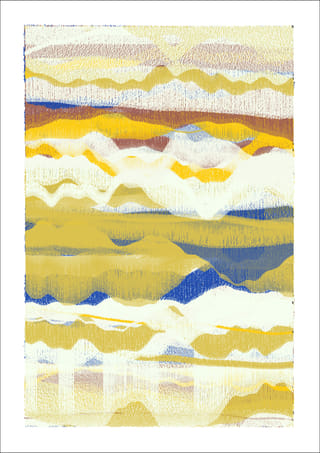
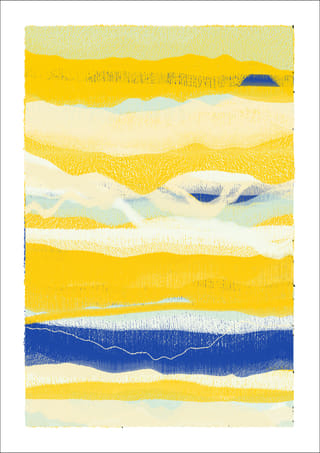
Lines gather into layers. Layers begin to suggest distance. A landscape appears, although no place was drawn.

STRATA
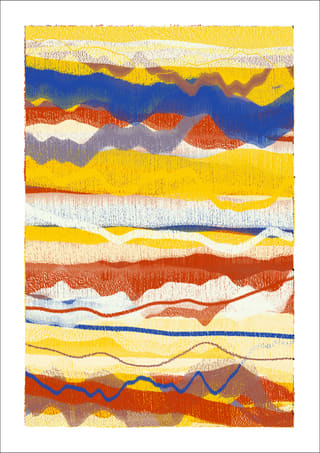
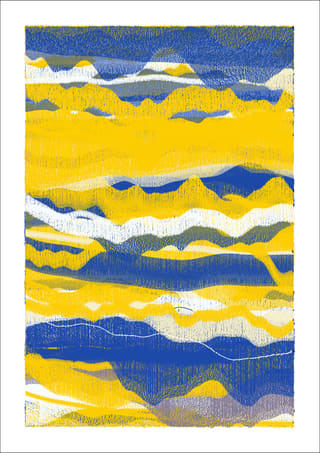
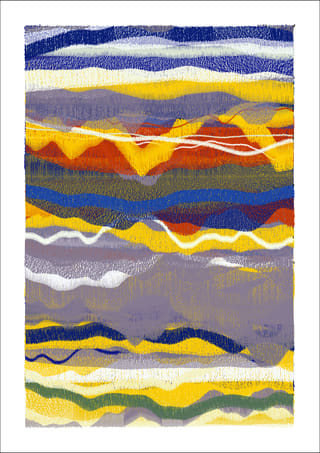
Bright vertical abstract composition with dense lemon-yellow, cobalt-blue, vermilion, cream, and grey-violet layers crossed by fine red and blue lines.

Strata / 154—51—253

  • Strata 01
  • 1240 × 1754 px
  • Signal
  • Sequence 11 / 30

View the collection Read the process

Strata · 30 selected works

One system, many climates.
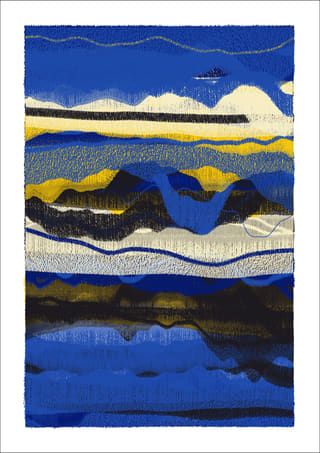
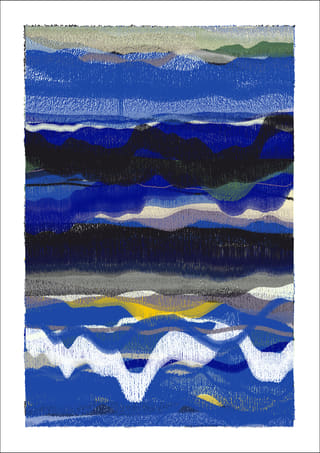
Dense vertical abstract composition of deep blue and black layers interrupted by cream, muted gold, and thin grey lines.
Strata / 113—784—29
Vertical abstract composition with dark green, slate, and charcoal layers at the top and bottom surrounding a large pale mint and white center.
Strata / 284—351—38
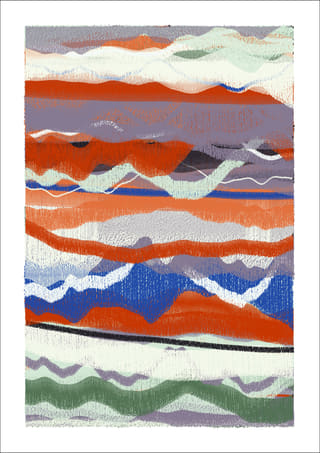
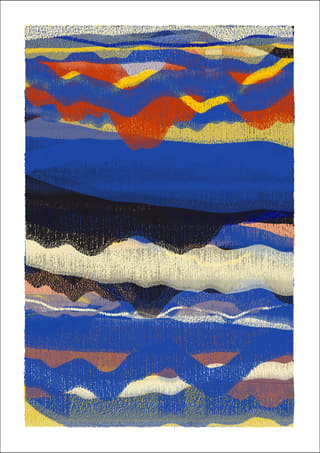
High-contrast vertical abstract work of coral, near-black, cream, and lavender-grey layers crossed by looping pale and orange lines.
Strata / 402—444—36
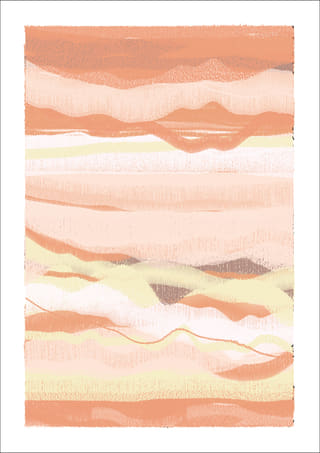
Low-contrast vertical abstract image in salmon, blush, cream, and pale yellow, with soft horizontal layers and faint wavering lines.
Strata / 478—172—4
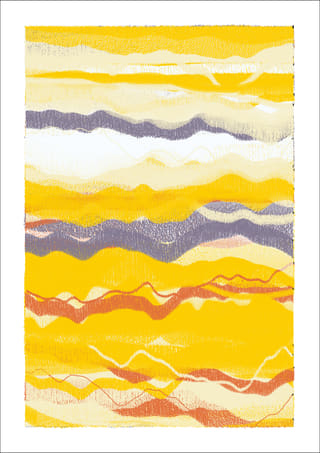
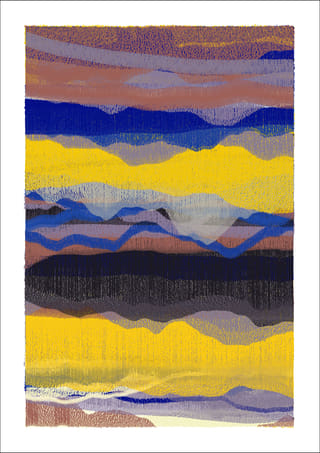
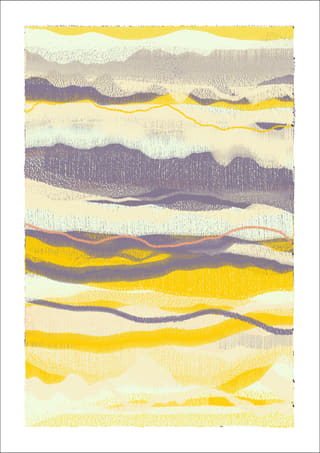
Vertical abstract work dominated by saffron yellow and cream, crossed by narrow peach, rust, and lavender-grey layers and lines.
Strata / 534—179—79

See all works

The system

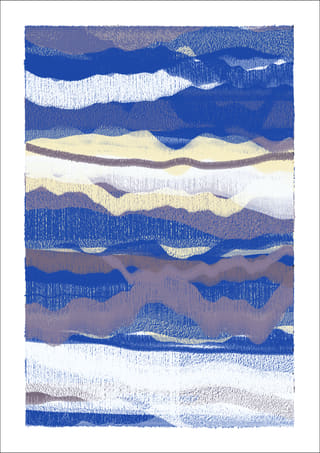
Rules leave a surface.

The work is not prompted. It is run.

How Strata is made

  1. 01Establish the field
  2. 02Build a working palette
  3. 03Divide recursively
  4. 04Disturb the boundaries
  5. 05Draw through repetition
  6. 06Layer and contain
  7. 07Save a trace

Code as an image-making practice
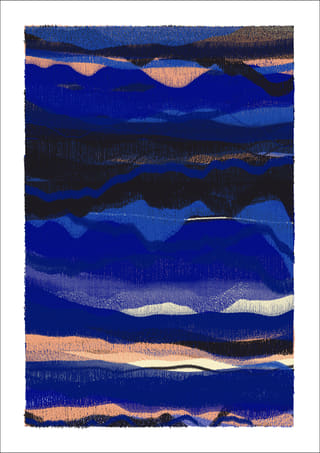
Dark vertical abstract work in ultramarine, midnight blue, and black-violet, interrupted by narrow peach layers and one short pale line.
Strata / 552—142—79

Strata is coded generative art, made in JavaScript with p5.js. The image is produced by a system of authored rules, pseudo-random choices, and repeated drawing operations—not by a text-to-image model.
Collection

Strata 01 · 2025 · 30 works

Thirty states of one system.

A generative study in layers, pressure, and distance.

The works are arranged as a visual sequence rather than by filename. Move through them in order, or open the proof sheet to compare the series at once.

  • 30 selected outputs
  • Custom JavaScript + p5.js
  • 1240 × 1754 px
  • Portrait format

Read the notes

View
Order

Light

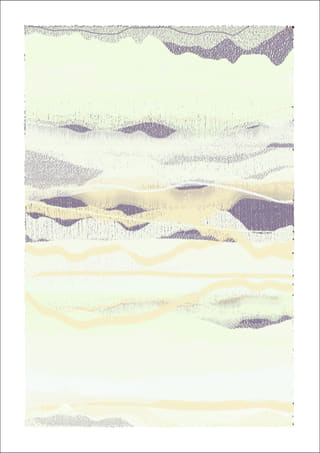
The sequence begins where the system recedes. Pale color, broad intervals, and incomplete marks leave room for the page to participate.

Very pale vertical abstract image with near-white and mint layers, faint grey-violet edges, and large areas of open light space.

01 Strata / 170—255—4 01 Light

Off-white, very pale mint, soft grey, faint lavender.

Light
94
Temp
+12
Density
01

The drawing approaches disappearance. Much of its information sits just above white, with a few grey-violet edges holding the upper and lower fields apart. It asks for slower looking than the more chromatic works.

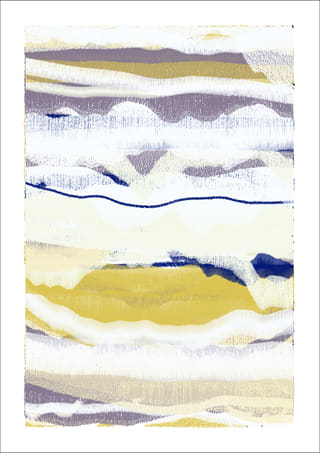
Very pale vertical abstract image with large white areas, faint grey and yellow layers, and one thin navy line across the center.

02 Strata / 520—281—246 01 Light

Off-white, pale grey, muted yellow, navy.

Light
89
Temp
+13
Density
39

This work leaves more of the page open than the others. Several layers nearly vanish into white, leaving a grey upper trace and a dark blue line to carry the page. Absence becomes a compositional decision rather than a pause between events.

Vertical abstract composition of pale yellow, cream, and soft grey-violet layers, with light textured marks and several narrow ochre lines.

03 Strata / 30—52—27 01 Light

Pale yellow, cream, grey-violet, muted ochre.

Light
85
Temp
+47
Density
26

The palette stays close to the paper, so the image appears gradually. Grey-violet seams gather and separate the pale yellows. It is an exercise in low contrast: nothing insists, but the field never becomes empty.

Vertical abstract composition with dark green, slate, and charcoal layers at the top and bottom surrounding a large pale mint and white center.

04 Strata / 284—351—38 01 Light

Pale mint, forest green, slate blue, charcoal, white.

Light
84
Temp
−05
Density
43

The image concentrates its darker weight near the top and bottom, leaving a long pale interval between them. That interval becomes active: mist, paper, distance, or simply the part the system chose not to fill.

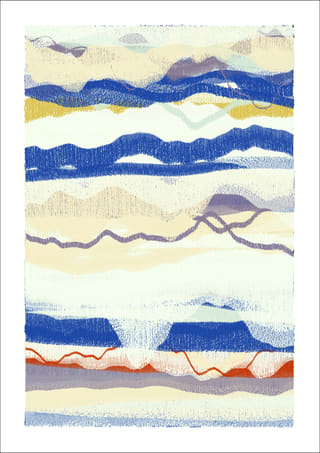
Vertical abstract work with cream, slate-blue, pale-mint, and grey layers, plus a thin rust-colored line near the bottom.

05 Strata / 606—266—134 01 Light

Cream, slate blue, pale mint, grey, rust.

Light
84
Temp
−10
Density
53

Blue ribbons move through a cream field with enough separation to remain individually visible. A single rust line near the bottom changes the temperature of the whole page. The sequence can end here without feeling closed.

The page warms. Sparse intervals begin to hold color for longer.

Heat

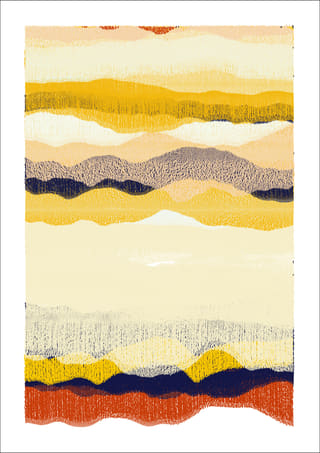
Peach, sand, rust, and yellow shift the work from distance toward exposure. The layers remain soft, but the color carries more weight.

Vertical abstract work with cream and golden horizontal layers, a broad pale central gap, a grey-violet seam, and a burnt-orange band at the bottom.

06 Strata / 64—830—251 02 Heat

Sand, cream, gold, lavender-grey, burnt orange.

Light
83
Temp
+66
Density
21

A wide pale interval divides the page without making it feel broken. Gold and grey collect above it; rust settles at the lower edge. The empty center acts less like missing information than a distance between two events.

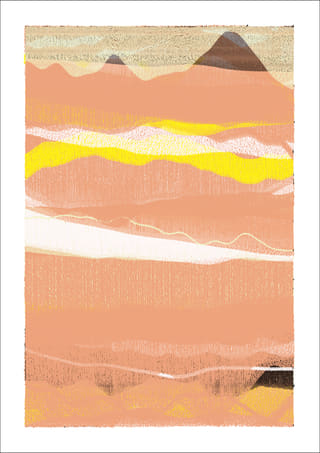
Mostly salmon and blush vertical abstract work with a dark triangular form near the top, a bright yellow seam, and pale cream layers.

07 Strata / 189—231—244 02 Heat

Salmon, blush, lemon, cream, dark brown.

Light
81
Temp
+95
Density
01

A dark form briefly resembles a peak near the upper edge, then the image dissolves into a wide salmon field. A sharp yellow seam prevents the close tones from becoming passive. Recognition appears, then is covered.

Low-contrast vertical abstract image in salmon, blush, cream, and pale yellow, with soft horizontal layers and faint wavering lines.

08 Strata / 478—172—4 02 Heat

Salmon, blush, cream, pale yellow.

Light
88
Temp
+59
Density
00

The structure is carried by small tonal shifts within salmon and blush. Cream lines surface and recede; a faint yellow area changes the lower field. Its restraint makes texture more visible than outline.

Light vertical abstract composition with cream, peach, pale yellow, and lavender-grey layers, softly textured and widely spaced.

09 Strata / 443—192—253 02 Heat

Cream, peach, pale yellow, lavender-grey.

Light
83
Temp
+51
Density
27

Color arrives in restrained fragments rather than large declarations. Peach and lavender-grey gather around a cream ground, while yellow appears as a thin change in temperature. The work remains light without becoming delicate.

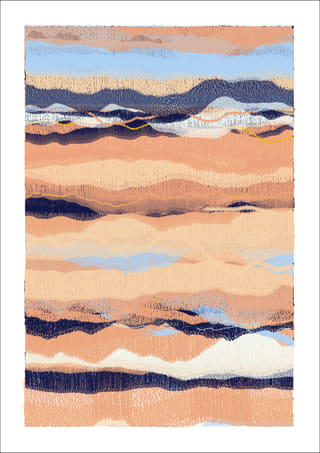
Vertical abstract work of dusty peach, cream, pale blue, mauve, and navy horizontal layers with fine fibrous texture.

10 Strata / 136—704—199 02 Heat

Dusty peach, pale blue, cream, mauve, navy.

Light
76
Temp
+45
Density
51

Peach fills much of the page, but it is repeatedly cooled by pale blue and a narrow navy seam. The composition stays measured and lateral, like a long section seen through changing light.

A blue line enters the warm field. Contrast becomes structural.

Signal

Yellow and blue behave like opposing forces. Thin lines cross wider regions; color begins to read as information as much as atmosphere.

Bright vertical abstract composition with dense lemon-yellow, cobalt-blue, vermilion, cream, and grey-violet layers crossed by fine red and blue lines.

11 Strata / 154—51—253 03 Signal

Lemon yellow, cobalt, vermilion, cream, grey-violet.

Light
76
Temp
+74
Density
59

Here the palette does not settle into atmosphere. Yellow, blue, red, and violet stay distinct, meeting at abrupt edges or passing through one another as thin signals. The friction between them makes the system’s layered construction easy to see.

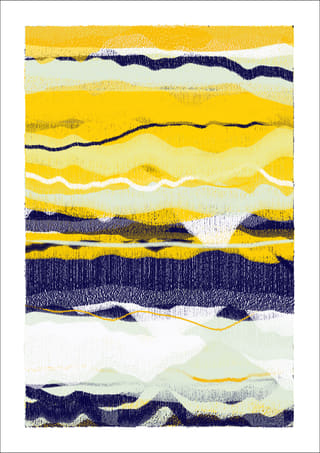
Vertical abstract composition of vivid yellow, navy, black, pale mint, and white horizontal layers with irregular textured edges.

12 Strata / 200—851—10 03 Signal

Yellow, navy, black, pale mint, white.

Light
76
Temp
+40
Density
75

Yellow and navy alternate in broad, decisive sections. Smaller black and mint interruptions keep the composition from becoming a simple two-color pattern. The result reads quickly from a distance and becomes much less stable up close.

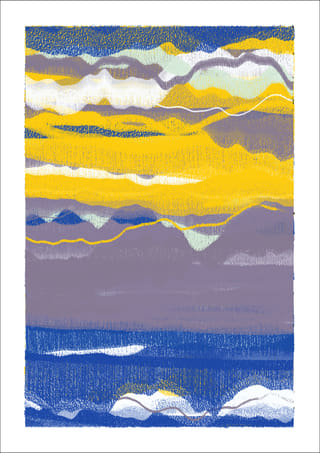
Vertical abstract composition with yellow and grey-violet layers above a broad cobalt lower field and two small pale angular shapes at the bottom.

13 Strata / 514—696—29 03 Signal

Yellow, grey-violet, cobalt, cream, muted green.

Light
68
Temp
−02
Density
40

The upper field is active with yellow and violet; the lower field settles into a broad blue mass. Two pale angular forms at the base introduce a brief, almost illustrative foreground before returning to texture.

Dense vertical abstract work of alternating cobalt-blue, bright-yellow, cream, and grey-violet horizontal layers.

14 Strata / 518—222—4 03 Signal

Cobalt, bright yellow, cream, grey-violet.

Light
72
Temp
+29
Density
51

Blue and yellow trade places through a tightly packed stack. Neither becomes ground or accent for long. The repeated exchange makes the image feel continuous, as if the visible page were one section cut from a longer field.

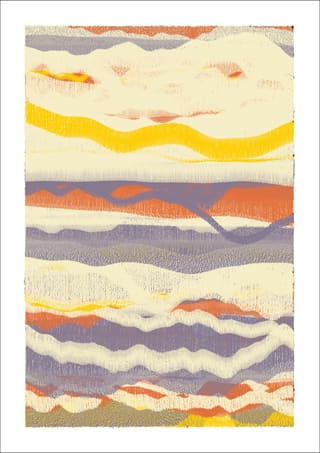
Vertical abstract work dominated by saffron yellow and cream, crossed by narrow peach, rust, and lavender-grey layers and lines.

15 Strata / 534—179—79 03 Signal

Saffron yellow, cream, peach, rust, lavender-grey.

Light
86
Temp
+92
Density
16

Yellow fills the page, but thin rust and lavender traces keep opening routes through it. The color is direct; the drawing remains unsettled. At close range, its broad fields turn back into rows of individual marks.

Brightness recedes. The layers tighten and darken.

Compression

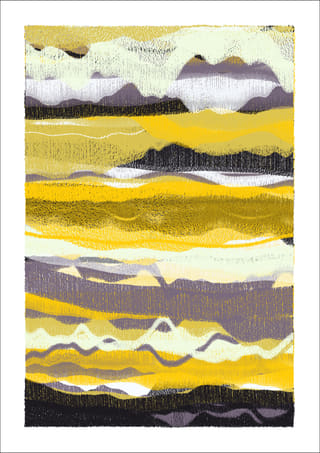
Ochre, black, coral, rust, and plum make the strata feel closer together. Overlap is less atmospheric here; it becomes pressure.

Vertical abstract composition of ochre, muted yellow, black, cream, and lavender-grey layers, densely grouped through the middle.

16 Strata / 296—705—248 04 Compression

Ochre, muted yellow, black, cream, lavender-grey.

Light
73
Temp
+56
Density
65

Ochre and black give this work a mineral weight. The central stack is tight, with narrow light passages separating darker masses. A pale upper edge and open lower marks keep the pressure from closing the field entirely.

High-contrast vertical abstract work of coral, near-black, cream, and lavender-grey layers crossed by looping pale and orange lines.

17 Strata / 402—444—36 04 Compression

Coral, near-black, cream, lavender-grey.

Light
69
Temp
+52
Density
78

Coral and black meet with little mediation. Their broad regions are cut by cream loops and narrow violet traces, making the page feel active and abrasive. The lower half opens slightly, but never becomes quiet.

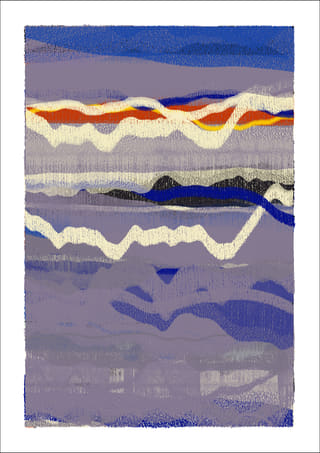
Vertical abstract work with alternating rust-red, cobalt-blue, grey, dark-green, and cream layers that form several diagonal crossings.

18 Strata / 458—309—3 04 Compression

Rust red, cobalt, grey, dark green, cream.

Light
69
Temp
+35
Density
63

Rust and blue pass through the page in alternating currents, repeatedly interrupted by grey, green, and white. The overlaps create diagonal tensions inside an otherwise horizontal system. It is one of the selection’s more restless works.

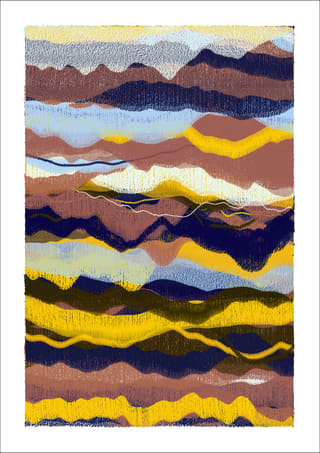
Dense vertical abstract work of golden ochre, khaki, black-brown, and cream layers with granular, fibrous texture.

19 Strata / 504—618—134 04 Compression

Golden ochre, khaki, black-brown, cream.

Light
74
Temp
+74
Density
60

Closely related earth tones create a compact, seam-like field. Black-brown layers emerge from the ochre rather than sitting on top of it. The image is heavy, but its fine surface keeps that weight from becoming blunt.

Dense vertical abstract composition of plum, chocolate brown, ochre, pale blue, and cream horizontal layers with a woven texture.

20 Strata / 564—847—252 04 Compression

Plum, chocolate brown, ochre, pale blue, cream.

Light
58
Temp
+37
Density
77

Brown, plum, and ochre form a dense woven stack. Pale blue and cream pass through as cooler seams rather than open space. The unusually earthy palette makes the line texture feel especially close to cloth or print.

Warmth falls away. The field opens into blue.

Depth

The blue works create a pronounced illusion of distance. Their white seams read as light, water, snow, or interruption without settling on one of them.

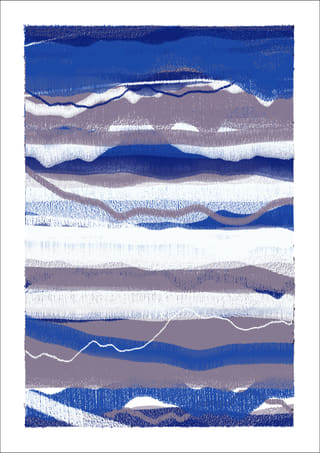
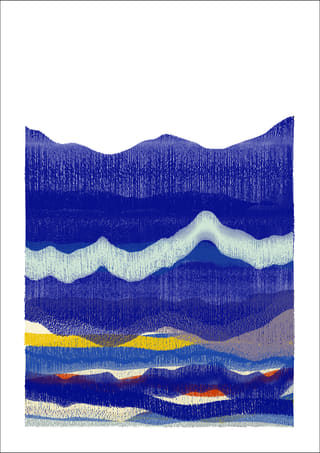
Vertical abstract work composed of irregular cobalt, dark blue, grey, and white horizontal layers, with two thin wavering lines crossing the lower half.

21 Strata / 13—476—4 05 Depth

Cobalt, ultramarine, slate, paper white.

Light
65
Temp
−55
Density
68

Blue carries the spatial structure here. Dense upper layers press against quieter grey and white intervals, while two fine wandering lines refuse the heavier rhythm around them. The image feels deep without relying on conventional perspective.

Dense vertical abstract composition of deep blue and black layers interrupted by cream, muted gold, and thin grey lines.

22 Strata / 113—784—29 05 Depth

Ultramarine, ink blue, black, cream, dull gold.

Light
48
Temp
−60
Density
68

One of the darker states of the system. Black and blue compress the middle, while cream and muted gold break through in narrow, uneven passages. The layers feel less deposited than forced against one another.

Vertical abstract work made of cobalt, periwinkle, grey-violet, and white horizontal layers with soft uneven contours.

23 Strata / 356—584—134 05 Depth

Cobalt, periwinkle, grey-violet, white.

Light
67
Temp
−61
Density
51

Blue is distributed in wider, calmer regions than in the darker works. White layers interrupt the middle at regular intervals, giving the composition a measured rhythm while fine marks roughen every edge.

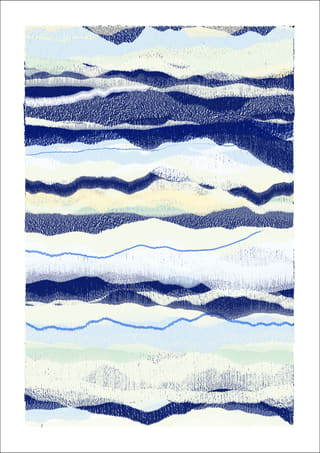
Light vertical abstract composition of white, icy blue, pale mint, and navy layers with several distinct dark-blue wavering lines.

24 Strata / 549—389—245 05 Depth

Navy, icy blue, pale mint, white.

Light
79
Temp
−30
Density
100

Dark blue lines remain separate inside an unusually light field. They read as depth, but also as marks on a surface. The work moves between landscape and drawing more openly than many others in the series.

Dark vertical abstract work in ultramarine, midnight blue, and black-violet, interrupted by narrow peach layers and one short pale line.

25 Strata / 552—142—79 05 Depth

Ultramarine, midnight blue, black-violet, peach.

Light
35
Temp
−90
Density
40

A deep blue field is relieved by a few peach passages and one short pale line. Subtle value changes carry the rest. The image feels continuous and nocturnal, with little separation between layer and depth.

Blue remains, but certainty loosens. Mixed palettes return.

Return

The final group does not resolve the collection. It brings pale greens, violet, ochre, yellow, and blue back into unstable balance, leaving the system open.

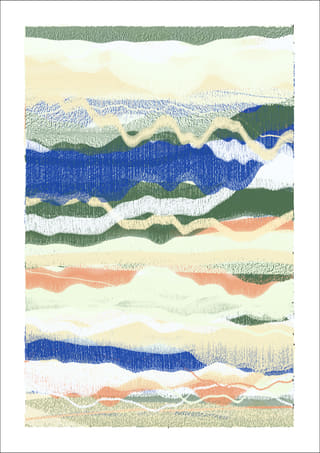
Light vertical abstract work with cream, sea-green, blue, peach, and grey bands of varying thickness and several thin wandering lines.

26 Strata / 248—778—134 06 Return

Cream, sea green, muted blue, peach, soft grey.

Light
83
Temp
−02
Density
45

Several color families coexist without one taking control. Green and blue supply a loose horizon; peach and grey move through the lower layers as smaller incidents. The image feels assembled, but not crowded.

Vertical abstract work with grey-violet, peach, cream, cobalt, and yellow layers, ending in small angular blue and pale forms at the bottom.

27 Strata / 293—726—248 06 Return

Grey-violet, peach, cobalt, cream, yellow.

Light
70
Temp
+02
Density
37

Muted violet and peach form a steady upper field before a blue and yellow line pulls attention downward. Small triangular forms at the base introduce a more explicit sense of terrain, then stop short of illustration.

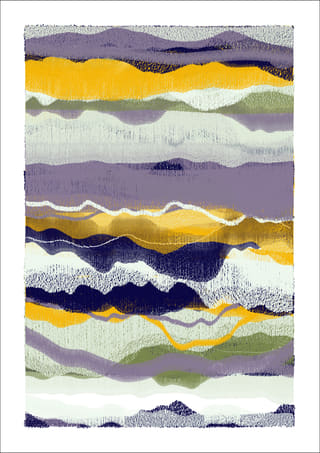
Vertical abstract composition of violet-grey, sage green, mustard, navy, and cream bands with several narrow dark seams.

28 Strata / 383—230—239 06 Return

Violet-grey, sage, mustard, navy, cream.

Light
71
Temp
+15
Density
66

The restrained palette shifts gradually between violet, sage, and mustard. Darker seams divide the page without dominating it. It has the steadiness of a core sample: difference registered through small changes rather than spectacle.

Vertical abstract composition of milky white, lemon yellow, ochre, pale blue, and soft grey layers with many open light gaps.

29 Strata / 498—367—251 06 Return

Milky white, lemon, ochre, pale blue, soft grey.

Light
86
Temp
+47
Density
25

White breaks the colored layers into separate islands. Yellow and ochre hold the composition together, while pale blue cools its center. The work feels porous, with more page passing through the image than usual.

Vertical abstract work dominated by yellow and cream, with pale-blue layers and a long navy band across the lower third.

30 Strata / 508—167—79 06 Return

Bright yellow, cream, pale blue, navy.

Light
86
Temp
+60
Density
03

A long yellow field is interrupted by a low blue horizon and a small dark form near the right edge. The upper layers remain open and pale. A few elements are enough to give the page a clear sense of orientation.

The sequence ends with a horizon, not a conclusion.

Light vertical abstract work with cream, sea-green, blue, peach, and grey bands of varying thickness and several thin wandering lines.

DetailStrata / 248—778—13426 of 30Return

Measured 30 works · 03 readings

The profile

Light, temperature and density, taken off each file's own pixels and drawn in curatorial order. Light falls from 94 at the first work to 35 in Depth; Return takes it back to 86. The order is not a hang. It is a descent and a recovery.

Read colour as climate

  1. 01 Strata / 170—255—4 Light L 94 · T +12 · D 01
  2. 02 Strata / 520—281—246 Light L 89 · T +13 · D 39
  3. 03 Strata / 30—52—27 Light L 85 · T +47 · D 26
  4. 04 Strata / 284—351—38 Light L 84 · T −05 · D 43
  5. 05 Strata / 606—266—134 Light L 84 · T −10 · D 53
  6. 06 Strata / 64—830—251 Heat L 83 · T +66 · D 21
  7. 07 Strata / 189—231—244 Heat L 81 · T +95 · D 01
  8. 08 Strata / 478—172—4 Heat L 88 · T +59 · D 00
  9. 09 Strata / 443—192—253 Heat L 83 · T +51 · D 27
  10. 10 Strata / 136—704—199 Heat L 76 · T +45 · D 51
  11. 11 Strata / 154—51—253 Signal L 76 · T +74 · D 59
  12. 12 Strata / 200—851—10 Signal L 76 · T +40 · D 75
  13. 13 Strata / 514—696—29 Signal L 68 · T −02 · D 40
  14. 14 Strata / 518—222—4 Signal L 72 · T +29 · D 51
  15. 15 Strata / 534—179—79 Signal L 86 · T +92 · D 16
  16. 16 Strata / 296—705—248 Compression L 73 · T +56 · D 65
  17. 17 Strata / 402—444—36 Compression L 69 · T +52 · D 78
  18. 18 Strata / 458—309—3 Compression L 69 · T +35 · D 63
  19. 19 Strata / 504—618—134 Compression L 74 · T +74 · D 60
  20. 20 Strata / 564—847—252 Compression L 58 · T +37 · D 77
  21. 21 Strata / 13—476—4 Depth L 65 · T −55 · D 68
  22. 22 Strata / 113—784—29 Depth L 48 · T −60 · D 68
  23. 23 Strata / 356—584—134 Depth L 67 · T −61 · D 51
  24. 24 Strata / 549—389—245 Depth L 79 · T −30 · D 100
  25. 25 Strata / 552—142—79 Depth L 35 · T −90 · D 40
  26. 26 Strata / 248—778—134 Return L 83 · T −02 · D 45
  27. 27 Strata / 293—726—248 Return L 70 · T +02 · D 37
  28. 28 Strata / 383—230—239 Return L 71 · T +15 · D 66
  29. 29 Strata / 498—367—251 Return L 86 · T +47 · D 25
  30. 30 Strata / 508—167—79 Return L 86 · T +60 · D 03
Largest step
1.00Strata / 248—778—134

Strata holds two kinds of time. There is the quick time of a system producing an output, and the slower time suggested by what it draws: settling, pressure, erosion, return.

The code finishes. The image continues to accumulate in the eye.

Editions

Ahead of the first edition.

Prints are being prepared as numbered editions. Leave an address and you will hear what they are — paper, process, size, edition size, and price — before they are listed publicly.

One message when there is an edition to announce, and nothing else. Unsubscribe at any time.

Very pale vertical abstract image with near-white and mint layers, faint grey-violet edges, and large areas of open light space.
Strata / 170—255—4

Movement 01 of 06

Light

The sequence begins where the system recedes. Pale color, broad intervals, and incomplete marks leave room for the page to participate.

Lightness
87
Temperature
+11
Density
32
Works
5

The drawing approaches disappearance. Much of its information sits just above white, with a few grey-violet edges holding the upper and lower fields apart. It asks for slower looking than the more chromatic works.

Off-white, very pale mint, soft grey, faint lavender.

The drawing 100 per cent accumulated.

The grammar, at your own pace

  1. 01Establish the field620 × 877 · inset 50 px
  2. 02Build a working palette234 readings · 30 kept
  3. 03Divide recursively73 regions · 37 leaves · h > 50
  4. 04Disturb the boundariesnoiseLevel 30–260 · noiseScale 0.001–0.008
  5. 05Draw through repetitiontexturizedLine2 · 12 points · × 2
  6. 06Layer and contain616,426 marks · clipped at 50 px
  7. 07Save a trace409, 296, 4 → filename

Run 154—51—253 · 620 × 877 · 616,426 marks

Very pale vertical abstract image with large white areas, faint grey and yellow layers, and one thin navy line across the center.
Strata / 520—281—246
Vertical abstract composition of pale yellow, cream, and soft grey-violet layers, with light textured marks and several narrow ochre lines.
Strata / 30—52—27
Vertical abstract composition with dark green, slate, and charcoal layers at the top and bottom surrounding a large pale mint and white center.
Strata / 284—351—38
Vertical abstract work with cream, slate-blue, pale-mint, and grey layers, plus a thin rust-colored line near the bottom.
Strata / 606—266—134

Measured

WorkLightnessTemperatureDensity
170—255—4 94 +12 1
520—281—246 89 +13 39
30—52—27 85 +47 26
284—351—38 84 −05 43
606—266—134 84 −10 53

The page warms. Sparse intervals begin to hold color for longer.

Next movement Heat
Vertical abstract work with cream and golden horizontal layers, a broad pale central gap, a grey-violet seam, and a burnt-orange band at the bottom.
Strata / 64—830—251

Movement 02 of 06

Heat

Peach, sand, rust, and yellow shift the work from distance toward exposure. The layers remain soft, but the color carries more weight.

Lightness
82
Temperature
+63
Density
20
Works
5

A wide pale interval divides the page without making it feel broken. Gold and grey collect above it; rust settles at the lower edge. The empty center acts less like missing information than a distance between two events.

Sand, cream, gold, lavender-grey, burnt orange.

The drawing 100 per cent accumulated.

The grammar, at your own pace

  1. 01Establish the field620 × 877 · inset 50 px
  2. 02Build a working palette234 readings · 30 kept
  3. 03Divide recursively73 regions · 37 leaves · h > 50
  4. 04Disturb the boundariesnoiseLevel 30–260 · noiseScale 0.001–0.008
  5. 05Draw through repetitiontexturizedLine2 · 12 points · × 2
  6. 06Layer and contain616,426 marks · clipped at 50 px
  7. 07Save a trace409, 296, 4 → filename

Run 154—51—253 · 620 × 877 · 616,426 marks

Mostly salmon and blush vertical abstract work with a dark triangular form near the top, a bright yellow seam, and pale cream layers.
Strata / 189—231—244
Low-contrast vertical abstract image in salmon, blush, cream, and pale yellow, with soft horizontal layers and faint wavering lines.
Strata / 478—172—4
Light vertical abstract composition with cream, peach, pale yellow, and lavender-grey layers, softly textured and widely spaced.
Strata / 443—192—253
Vertical abstract work of dusty peach, cream, pale blue, mauve, and navy horizontal layers with fine fibrous texture.
Strata / 136—704—199

Measured

WorkLightnessTemperatureDensity
64—830—251 83 +66 21
189—231—244 81 +95 1
478—172—4 88 +59 0
443—192—253 83 +51 27
136—704—199 76 +45 51

A blue line enters the warm field. Contrast becomes structural.

Next movement Signal
Bright vertical abstract composition with dense lemon-yellow, cobalt-blue, vermilion, cream, and grey-violet layers crossed by fine red and blue lines.
Strata / 154—51—253

Movement 03 of 06

Signal

Yellow and blue behave like opposing forces. Thin lines cross wider regions; color begins to read as information as much as atmosphere.

Lightness
76
Temperature
+47
Density
48
Works
5

Here the palette does not settle into atmosphere. Yellow, blue, red, and violet stay distinct, meeting at abrupt edges or passing through one another as thin signals. The friction between them makes the system’s layered construction easy to see.

Lemon yellow, cobalt, vermilion, cream, grey-violet.

The drawing 100 per cent accumulated.

The grammar, at your own pace

  1. 01Establish the field620 × 877 · inset 50 px
  2. 02Build a working palette234 readings · 30 kept
  3. 03Divide recursively73 regions · 37 leaves · h > 50
  4. 04Disturb the boundariesnoiseLevel 30–260 · noiseScale 0.001–0.008
  5. 05Draw through repetitiontexturizedLine2 · 12 points · × 2
  6. 06Layer and contain616,426 marks · clipped at 50 px
  7. 07Save a trace409, 296, 4 → filename

Run 154—51—253 · 620 × 877 · 616,426 marks

Vertical abstract composition of vivid yellow, navy, black, pale mint, and white horizontal layers with irregular textured edges.
Strata / 200—851—10
Vertical abstract composition with yellow and grey-violet layers above a broad cobalt lower field and two small pale angular shapes at the bottom.
Strata / 514—696—29
Dense vertical abstract work of alternating cobalt-blue, bright-yellow, cream, and grey-violet horizontal layers.
Strata / 518—222—4
Vertical abstract work dominated by saffron yellow and cream, crossed by narrow peach, rust, and lavender-grey layers and lines.
Strata / 534—179—79

Measured

WorkLightnessTemperatureDensity
154—51—253 76 +74 59
200—851—10 76 +40 75
514—696—29 68 −02 40
518—222—4 72 +29 51
534—179—79 86 +92 16

Brightness recedes. The layers tighten and darken.

Next movement Compression
Vertical abstract composition of ochre, muted yellow, black, cream, and lavender-grey layers, densely grouped through the middle.
Strata / 296—705—248

Movement 04 of 06

Compression

Ochre, black, coral, rust, and plum make the strata feel closer together. Overlap is less atmospheric here; it becomes pressure.

Lightness
69
Temperature
+51
Density
69
Works
5

Ochre and black give this work a mineral weight. The central stack is tight, with narrow light passages separating darker masses. A pale upper edge and open lower marks keep the pressure from closing the field entirely.

Ochre, muted yellow, black, cream, lavender-grey.

The drawing 100 per cent accumulated.

The grammar, at your own pace

  1. 01Establish the field620 × 877 · inset 50 px
  2. 02Build a working palette234 readings · 30 kept
  3. 03Divide recursively73 regions · 37 leaves · h > 50
  4. 04Disturb the boundariesnoiseLevel 30–260 · noiseScale 0.001–0.008
  5. 05Draw through repetitiontexturizedLine2 · 12 points · × 2
  6. 06Layer and contain616,426 marks · clipped at 50 px
  7. 07Save a trace409, 296, 4 → filename

Run 154—51—253 · 620 × 877 · 616,426 marks

High-contrast vertical abstract work of coral, near-black, cream, and lavender-grey layers crossed by looping pale and orange lines.
Strata / 402—444—36
Vertical abstract work with alternating rust-red, cobalt-blue, grey, dark-green, and cream layers that form several diagonal crossings.
Strata / 458—309—3
Dense vertical abstract work of golden ochre, khaki, black-brown, and cream layers with granular, fibrous texture.
Strata / 504—618—134
Dense vertical abstract composition of plum, chocolate brown, ochre, pale blue, and cream horizontal layers with a woven texture.
Strata / 564—847—252

Measured

WorkLightnessTemperatureDensity
296—705—248 73 +56 65
402—444—36 69 +52 78
458—309—3 69 +35 63
504—618—134 74 +74 60
564—847—252 58 +37 77

Warmth falls away. The field opens into blue.

Next movement Depth
Vertical abstract work composed of irregular cobalt, dark blue, grey, and white horizontal layers, with two thin wavering lines crossing the lower half.
Strata / 13—476—4

Movement 05 of 06

Depth

The blue works create a pronounced illusion of distance. Their white seams read as light, water, snow, or interruption without settling on one of them.

Lightness
59
Temperature
−59
Density
65
Works
5

Blue carries the spatial structure here. Dense upper layers press against quieter grey and white intervals, while two fine wandering lines refuse the heavier rhythm around them. The image feels deep without relying on conventional perspective.

Cobalt, ultramarine, slate, paper white.

The drawing 100 per cent accumulated.

The grammar, at your own pace

  1. 01Establish the field620 × 877 · inset 50 px
  2. 02Build a working palette234 readings · 30 kept
  3. 03Divide recursively73 regions · 37 leaves · h > 50
  4. 04Disturb the boundariesnoiseLevel 30–260 · noiseScale 0.001–0.008
  5. 05Draw through repetitiontexturizedLine2 · 12 points · × 2
  6. 06Layer and contain616,426 marks · clipped at 50 px
  7. 07Save a trace409, 296, 4 → filename

Run 154—51—253 · 620 × 877 · 616,426 marks

Dense vertical abstract composition of deep blue and black layers interrupted by cream, muted gold, and thin grey lines.
Strata / 113—784—29
Vertical abstract work made of cobalt, periwinkle, grey-violet, and white horizontal layers with soft uneven contours.
Strata / 356—584—134
Light vertical abstract composition of white, icy blue, pale mint, and navy layers with several distinct dark-blue wavering lines.
Strata / 549—389—245
Dark vertical abstract work in ultramarine, midnight blue, and black-violet, interrupted by narrow peach layers and one short pale line.
Strata / 552—142—79

Measured

WorkLightnessTemperatureDensity
13—476—4 65 −55 68
113—784—29 48 −60 68
356—584—134 67 −61 51
549—389—245 79 −30 100
552—142—79 35 −90 40

Blue remains, but certainty loosens. Mixed palettes return.

Next movement Return
Light vertical abstract work with cream, sea-green, blue, peach, and grey bands of varying thickness and several thin wandering lines.
Strata / 248—778—134

Movement 06 of 06

Return

The final group does not resolve the collection. It brings pale greens, violet, ochre, yellow, and blue back into unstable balance, leaving the system open.

Lightness
79
Temperature
+24
Density
35
Works
5

Several color families coexist without one taking control. Green and blue supply a loose horizon; peach and grey move through the lower layers as smaller incidents. The image feels assembled, but not crowded.

Cream, sea green, muted blue, peach, soft grey.

The drawing 100 per cent accumulated.

The grammar, at your own pace

  1. 01Establish the field620 × 877 · inset 50 px
  2. 02Build a working palette234 readings · 30 kept
  3. 03Divide recursively73 regions · 37 leaves · h > 50
  4. 04Disturb the boundariesnoiseLevel 30–260 · noiseScale 0.001–0.008
  5. 05Draw through repetitiontexturizedLine2 · 12 points · × 2
  6. 06Layer and contain616,426 marks · clipped at 50 px
  7. 07Save a trace409, 296, 4 → filename

Run 154—51—253 · 620 × 877 · 616,426 marks

Vertical abstract work with grey-violet, peach, cream, cobalt, and yellow layers, ending in small angular blue and pale forms at the bottom.
Strata / 293—726—248
Vertical abstract composition of violet-grey, sage green, mustard, navy, and cream bands with several narrow dark seams.
Strata / 383—230—239
Vertical abstract composition of milky white, lemon yellow, ochre, pale blue, and soft grey layers with many open light gaps.
Strata / 498—367—251
Vertical abstract work dominated by yellow and cream, with pale-blue layers and a long navy band across the lower third.
Strata / 508—167—79

Measured

WorkLightnessTemperatureDensity
248—778—134 83 −02 45
293—726—248 70 +02 37
383—230—239 71 +15 66
498—367—251 86 +47 25
508—167—79 86 +60 3

The sequence ends with a horizon, not a conclusion.

Next movement Light

Strata 01 · Notes §5 and §7 of the writing

The notes

Strata is a series of coded images built from horizontal regions and accumulated line. The system divides, disturbs, and redraws the field until structure begins to feel geological.

Passages
07
Words
772
Reading
3 min
Edition
Strata 01 · 2025

01

A name for what appeared

Strata began as a drawing system, not as a plan to imitate geology. I divided a vertical field into regions, moved their boundaries with noise, and built their surfaces from repeated lines.

What appeared was familiar without being identifiable. I could see horizons, cut earth, water, cloud, woven fiber, traces on a graph. No single reading held for long. The images kept returning to the idea of matter laid down over time.

That is where the name came from. Strata does not describe a subject the code was asked to draw. It describes what I found while looking at its results.

Very pale vertical abstract image with near-white and mint layers, faint grey-violet edges, and large areas of open light space.
Strata / 170—255—4

02

A landscape without a place

Landscape enters the work through arrangement rather than depiction. A dark region sits behind a pale one and becomes distance. A narrow wavering edge becomes a road or a fault. A wide blank interval becomes air.

The eye completes what the system leaves open. It brings its own memories of coastlines, mountains, maps, fabric, and weather. I am interested in that exchange: the image provides structure; the viewer provides recognition.

I do not see a location in these works. I see the conditions from which a location might be imagined.

Low-contrast vertical abstract image in salmon, blush, cream, and pale yellow, with soft horizontal layers and faint wavering lines.

Strata / 478—172—4

Salmon, blush, cream, pale yellow.

Light
88
Temp
+59
Density
00

03

From rule to material

Up close, the broad fields break apart. They are made from short marks with small variations, repeated until they carry color and weight. Their unevenness gives the surface a dry, fibrous quality.

That surface matters to me because it complicates the medium. Code is often associated with clean edges and perfect repetition. Here, repetition produces wear. The system leaves something closer to grain, thread, or rubbed pigment than to a polished vector shape.

Vertical abstract composition with yellow and grey-violet layers above a broad cobalt lower field and two small pale angular shapes at the bottom.
Strata / 514—696—29

04

Color as climate

The structure remains related from one output to the next, but color changes how it is read.

Blue and slate pull the layers into depth. Yellow makes them exposed and graphic. Peach and rust bring heat without making the image warm in a sentimental way. Green can feel botanical in one work and mineral in another. Near-white outputs slow the reading down until the drawing almost leaves the page.

The palette is not applied after the composition. It is one of the conditions through which the composition becomes visible.

High-contrast vertical abstract work of coral, near-black, cream, and lavender-grey layers crossed by looping pale and orange lines.

Strata / 402—444—36

Coral, near-black, cream, lavender-grey.

Light
69
Temp
+52
Density
78

05

Variation and selection

A generative system can make more images than anyone needs to keep. Production is only one part of the work.

I look for outputs that reveal a different behavior inside the same rules: an unexpected interval, a difficult color relation, a line that holds the field together, a composition that resists the others. The final selection includes forceful works and quiet ones because the series needs both.

The collection is therefore not a neutral sample of everything the code can do. It is an edit: 30 works drawn from an archive of 94 outputs.

Dense vertical abstract composition of deep blue and black layers interrupted by cream, muted gold, and thin grey lines.
Strata / 113—784—29

06

The generated signature

The identifiers preserve a small operation from the system. At the moment of saving, the code chooses a point from the input image and records its x coordinate, y coordinate, and red-channel value.

`154—51—253` is therefore not a descriptive title. It is an index made from a moment of looking. On the site, the work appears as Strata / 154—51—253; the matching public filename should be STRATA-154-51-253.

07

The artwork is a system and a selection.

Generative art is made through a process that can produce variation. The artist defines rules or behaviors; the system executes them; chance or changing inputs alter the result.

The code is not merely a tool used to finish an image already designed. It is part of the form. Writing a generative system means deciding what can happen, what cannot happen, and how much room exists between the two.

Is every output an artwork?

Every output belongs to the working process. The published collection is a smaller edit. In Strata, 30 works were selected from 94 saved outputs.

Is the computer the author?

The computer executes the instructions. The artist authors the rules, ranges, inputs, drawing behavior, stopping point, and selection. Unexpected results matter, but they arise inside a constructed field of possibility.

Is generative art the same as AI art?

No. Generative art is a broad practice and predates current image models by decades. Strata is produced by explicit drawing code: recursive subdivision, sampled color, noise, and repeated line. It does not use a text-to-image model.

Why keep more than one result?

Variation lets a system be seen from several sides. One output may emphasize structure, another color, another emptiness. The collection is the argument made by their differences.

Can a digital work have texture?

Not physical texture on the screen, but it can create a visual expectation of touch. In Strata, dense broken marks and slight variations in repetition suggest fiber, grain, and rubbed pigment.

Strata holds two kinds of time. There is the quick time of a system producing an output, and the slower time suggested by what it draws: settling, pressure, erosion, return.

The code finishes. The image continues to accumulate in the eye.

Return to the collection Read the process

Process

An image built by accumulation.

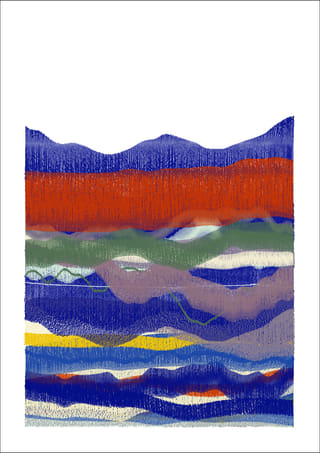
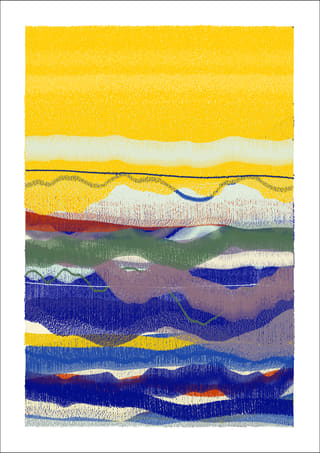
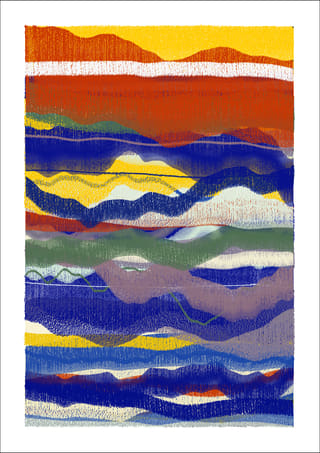
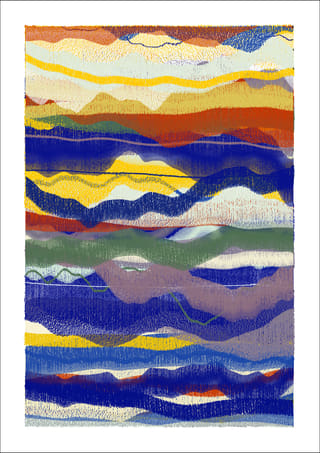
A slice of the finished drawing at actual size: dense vertical fibre in blue, ochre and violet.
Detail · 510 × 160 of 620 × 877 · actual size
The drawing 100 per cent accumulated.

01/ 07

Establish the field

620 × 877 · inset 50 px

Real pull

Run 154—51—253 · p5.js 1.8.0 · 620 × 877 · 616,426 marks

Not a prompt

Strata is written as a set of drawing conditions. Each run interprets them differently, but every output carries the same underlying grammar.

Strata is made with custom JavaScript and p5.js. It does not begin with a text description and it is not generated by an AI image model.
The code specifies a canvas, a palette, a way to divide space, a range of noise, and a textured line behavior. Pseudo-random choices alter how those parts combine. The result is rendered from those instructions each time the program runs.

A file of JavaScript that runs in a browser, about six hundred and seventy lines long. It calls two libraries I wrote for earlier collections and draws into a canvas close to the proportion of A-series paper.

There is no model, no training set, and no prompt. The facts of it are short enough to list, so they are listed.

Language
JavaScript · p5.js 1.8.0
Entry
gc.build(output, img, 620, 877)
Source
strata.html · 672 lines
Libraries
layouts.recursive.splitRect · brushs.texturizedLine2 · getImgColors
Input
one image · 620 × 877 px, from earlier work
Field
620 × 877 px · inset 50 px
Export
1240 × 1754 px
Randomness
unseeded — this run was given a seed

234 readings · 30 kept

The source

Colour is not chosen here. It is read.

The program opens one image, resizes it to the drawing field, and walks it on a fifty-pixel grid, keeping every value it lands on. Two hundred and thirty-four readings, of which thirty are kept at random. That array is the whole palette for the run, and once it is built the image is never looked at again except to sign the file.

The image it reads is not a photograph. It is a work of my own, made by an earlier system of mine. Colour arrives here having already been through a system once, which is why it holds together before anything has been composed.

30 values · read on a 50 px grid

The drawing sequence

Seven states of one plate

Two of the seven states are not pulls of the plate. They are diagrams.

The program divides the field into regions and never draws them. It computes a boundary for every region and never strokes it. Both exist only as numbers on their way to becoming marks. They are drawn here, alone, so the structure under the surface can be seen at all — and they are labelled, so they are not mistaken for the work.

  1. An empty white sheet at the drawing’s proportion, ruled with a single hairline at its edge.

    01

    Establish the field

    Real pull

    The canvas is vertical: 620 × 877 px in the archived source, exported at 1240 × 1754 px for the saved works. Its proportion is close to A-series paper, giving the outputs the bearing of pages or unbound posters.

    Field / format — An empty sheet at the proportion of a page, and a margin nothing may cross.

    Range
    620 × 877, fixed
    Measured
    620 × 877 · inset 50 px
    output.fill(255, 255, 255)
    output.rect(0, 0, gc.o.width, gc.o.height)
    strata.html:150–151
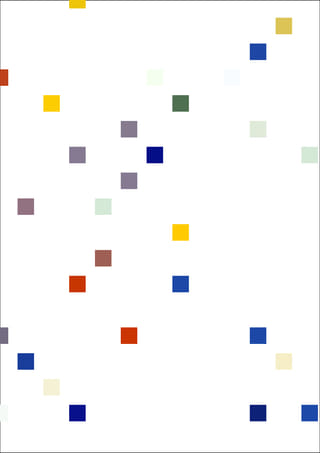
  2. The same white sheet with thirty small squares of sampled colour standing on the points they were read from.

    30 values · read on a 50 px grid, from one image

    02

    Build a working palette

    Reading

    The system reads color from an input image and creates a temporary array of sampled values. The image is a work of my own, made by an earlier system of mine — so the color has already been through one before it arrives here. This makes color relational from the beginning: the palette arrives with affinities and tensions already inside it.

    Input / palette — Color enters as sampled data, not as a fixed preset.

    Range
    234 readings → 30, with replacement
    Measured
    234 readings · 30 kept
    var n = 30
    for (let i = 0; i < n; i++) {
        var c = round(random(0, colors.length - 1));
        if (colors[c][0] !== undefined) {
            colorsArray.push(colors[c])
        }
    }
    strata.html:143–149
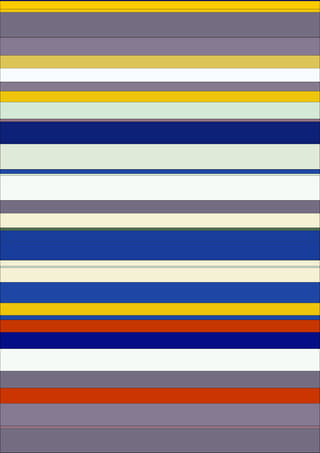
  3. The field divided into flat horizontal bands of sampled colour, every division ruled with a hairline.

    03

    Divide recursively

    Diagram

    The field is split into rectangular regions. Those regions are divided again, producing an underlying structure of horizontal sections at different depths.

    Recursive field — Repeated divisions establish the hidden structure of the page.

    Range
    random(0, 0.5) · stop at h ≤ 50
    Measured
    73 regions · 37 leaves · h > 50
    var splitWidth = random(1) > 0.5;
    var splitWhere = random(0, 0.5);
    if (splitWidth && w > splitW) { // 150
        split_rect(x, y, w * splitWhere, h);
        split_rect(x + (w * splitWhere), y, w * (1 - splitWhere), h);
    }
    else if (h > splitH) { // 150
        split_rect(x, y, w, h * splitWhere);
        split_rect(x, y + (h * splitWhere), w, h * (1 - splitWhere));
    }
    tools.js:3512–3522 · 1 commented line omitted
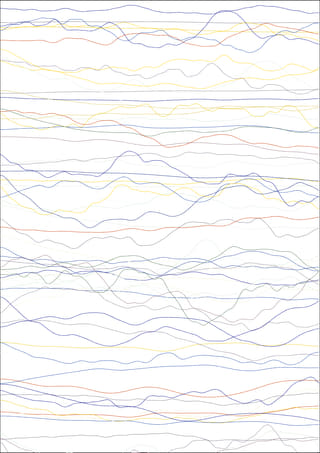
  4. Thin coloured lines crossing the sheet, each one bent by noise into a low ridge.

    04

    Disturb the boundaries

    Diagram

    Noise changes the height and course of each region. The divisions stop behaving like a grid and begin to resemble ridges, seams, or soft faults.

    Noise boundary — Controlled disturbance replaces the straight horizontal edge.

    Range
    noiseLevel 30–260 · noiseScale 0.001–0.008
    Measured
    noiseLevel 30–260 · noiseScale 0.001–0.008
    noiseLevel = random(30, 260);
    let noiseScale = random(0.001, 0.008);
    noiseSeed(random(0, 1000));
    var noiseLines = [];
    strata.html:195–204 · 5 commented lines omitted
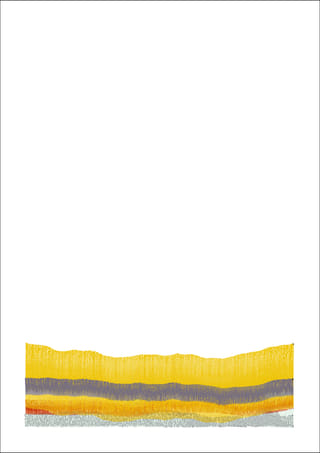
  5. The lower quarter of the sheet filled with dense vertical fibre; the rest still open white.

    05

    Draw through repetition

    Real pull

    The regions are not filled as solid shapes. A textured line routine moves through thousands of points, laying down small variations until an area appears. This is where the digital structure acquires its fibrous surface.

    Textured line — Accumulated marks turn a region into a surface.

    Range
    12 points · 2 iterations · ±4
    Measured
    texturizedLine2 · 12 points · × 2
    for (let i = 0; i < numCol; i += 2) {
        let xx = i;
        let noiseInput = noiseScale * i;
        let yy = noiseLevel * noise(noiseInput) + y;
        for (let j = 0; j < h; j += 2) {
            output.push();
            output.stroke(r, g, b)
            noiseLines.push([xx, yy - j])
    strata.html:207–215 · 1 commented line omitted
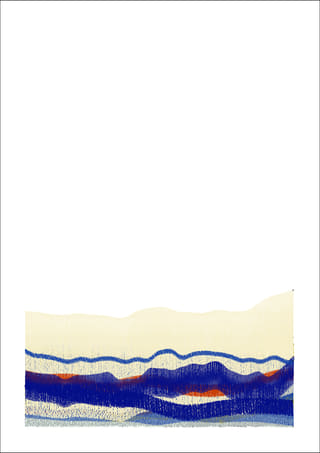
    1. The drawing 6 per cent accumulated.

      6% · 34,852

    2. The drawing 28 per cent accumulated.

      28% · 174,198

    3. The drawing 54 per cent accumulated.

      54% · 330,182

    4. The drawing 100 per cent accumulated.

      100% · 616,426

    73 regions, drawn in reverse. The surface arrives from the floor of the sheet upward.

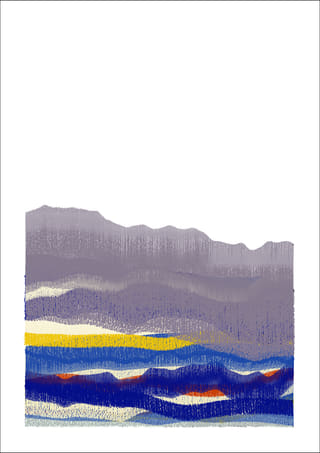
  6. The finished drawing: layered bands built from vertical fibre, held inside a white margin.

    06

    Layer and contain

    Real pull

    Regions are drawn in reverse sequence, so one can cover or interrupt another. The marks remain inside an inset boundary, leaving a white margin around the generated field.

    Layer order — Overlap creates depth, interruption, and occasional open space.

    Range
    inset 50 px, tested per mark
    Measured
    616,426 marks · clipped at 50 px
    var m = 50
    var p1 = createVector(m, m);
    var p2 = createVector(width - m, m);
    var p3 = createVector(width - m, height - m);
    var p4 = createVector(m, height - m);
    
    if ((isInside([noiseLines[p][0], noiseLines[p][1]], [p1, p2, p3, p4])) &&
        (isInside([noiseLines[p - 1][0], noiseLines[p - 1][1]], [p1, p2, p3, p4]))) {
        brushs.texturizedLine2(output, noiseLines[p - 1][0], noiseLines[p - 1][1], noiseLines[p][0], noiseLines[p][1], iterations, nPoints, nAmount, nVary, colorsArray, size, dotted, fade, isFilled, opacity)
    }
    strata.html:251–261
  7. 409, 296 → red 4

    STRATA-409-296-4

    07

    Save a trace

    Real pull · no ink of its own

    At export, the signature function samples one more coordinate from the input image. Its x value, y value, and red-channel value form the numeric part of the filename.

    Output / signature — A final sampled coordinate becomes part of the archive record.

    Range
    one coordinate · red channel only
    Measured
    409, 296, 4 → filename
    var x1 = Math.round(random(0, w));
    var y1 = Math.round(random(0, h));
    var c1 = gc.utils.get_pixel(img, x1, y1);
    var pos = x1 + '-' + y1;
    var color = c1[0];
    gc.o.sign = author + '-' + pos + '-' + color + '.jpg';
    strata.html:556–568 · 7 commented lines omitted

What chance does

Chance changes the palette choices, divisions, noise scale, noise amplitude, and the relationship between layers. It creates conditions I would be unlikely to compose one decision at a time.

Chance does not remove authorship. I decide what the system can vary, how far it can move, what kind of mark it can make, when a run is finished, and which results enter the collection.

  1. The finished drawing: layered bands built from vertical fibre, held inside a white margin.

    seed 154,051,253
    73 regions

  2. A different run of the same program: layered bands of sampled colour built from vertical fibre.

    +1
    69 regions

  3. A different run of the same program: layered bands of sampled colour built from vertical fibre.

    +2
    69 regions

  4. A different run of the same program: layered bands of sampled colour built from vertical fibre.

    +3
    55 regions

  5. A different run of the same program: layered bands of sampled colour built from vertical fibre.

    +4
    73 regions

  6. A different run of the same program: layered bands of sampled colour built from vertical fibre.

    +5
    81 regions

One number, changed by one. Everything else is the same program.

What selection does

The archive contains failed balances, useful tests, near repetitions, and works that open a direction without resolving it. They are part of the practice, but not all belong in the published series.

Selection turns output into sequence. I am not looking for thirty versions of the same success. I am looking for differences that make the system legible: density beside absence, heat beside cold, friction beside calm.

94 rendered · 30 published · 2025

Bright vertical abstract composition with dense lemon-yellow, cobalt-blue, vermilion, cream, and grey-violet layers crossed by fine red and blue lines.
Strata / 154—51—253

What remains uncontrolled

I can explain the operations that make Strata, but explanation does not exhaust the image. A rectangle divided by noise is still only a rectangle divided by noise. The landscape arrives later, in perception.

That distance between construction and recognition is where the work stays alive for me.

The same conditions. Not the same drawing.

Return to the collection Read the notes

Strata 01 · 2025

Information

Details on the work, files, rights, editions, and ways to get in touch.

Collection
Strata 01
Year
2025
Published
30
Archive
94
Movements
6
Format
1240 × 1754 px
Field
620 × 877 px, 50 px inset
Medium
Generative image; custom JavaScript and p5.js

What is Strata?

Strata is a collection of rule-based generative images created by a web developer working with custom JavaScript. The system divides a vertical field, disturbs its boundaries with noise, and redraws the resulting regions with textured line.

How many works are in the collection?

The published edit contains 30 works, selected from a saved archive of 94 outputs.

Was AI used to generate the images?

No text-to-image or generative AI model was used to make the Strata outputs. They were rendered by explicit JavaScript and p5.js drawing routines using palette sampling, recursive subdivision, pseudo-random choices, noise, and repeated line.

What do the numbers mean?

Each work identifier combines an x coordinate, a y coordinate, and the red-channel value of a sampled pixel. The numbers are generated identifiers, not edition numbers or a ranking of the works.
Are the works available as prints?

Print availability has not yet been announced. Register your interest below and you will hear when the first editions are ready, or write to hello@hmongouachon.com directly.

May I reproduce an image?

All images are protected by copyright. For editorial use, exhibitions, publishing, or licensing, contact hello@hmongouachon.com with the image signature, intended use, territory, and publication date.

Are commissions possible?

For commissions or collaborations involving generative systems, identity, installation, or print, write to hello@hmongouachon.com with a short outline and timeframe.

Press materials

A concise project text, creator profile, selected high-resolution images, captions, and technical credits are available on request.

Image credit format

Strata / 154—51—253, hmongouachon, [2025]. Generative image, custom JavaScript and p5.js. © hmongouachon.

Editions

Ahead of the first edition.

Prints are being prepared as numbered editions. Leave an address and you will hear what they are — paper, process, size, edition size, and price — before they are listed publicly.

One message when there is an edition to announce, and nothing else. Unsubscribe at any time.